SF6 switchgear maintenance often looks straightforward: check the pressure, connect the equipment, recover the gas and refill the compartment.
In practice, small mistakes at any stage can waste gas, extend the outage and create problems that may not appear until the equipment is returned to service.
The following seven mistakes are among the most common—and most avoidable.
Mistake 1: Refilling Before Finding the Leak
A falling pressure reading is a warning, not a diagnosis.
Adding SF6 may restore the pressure temporarily, but it does not solve the cause of the loss. If a valve, flange or sealing surface is still leaking, the new gas may escape again within days or months.
Before refilling, technicians should inspect the likely leakage points:
- Valves and valve connections
- Flanges and sealing surfaces
- Density monitor connections
- Pipe joints
- Bushings and compartment interfaces
- Hoses used during previous maintenance
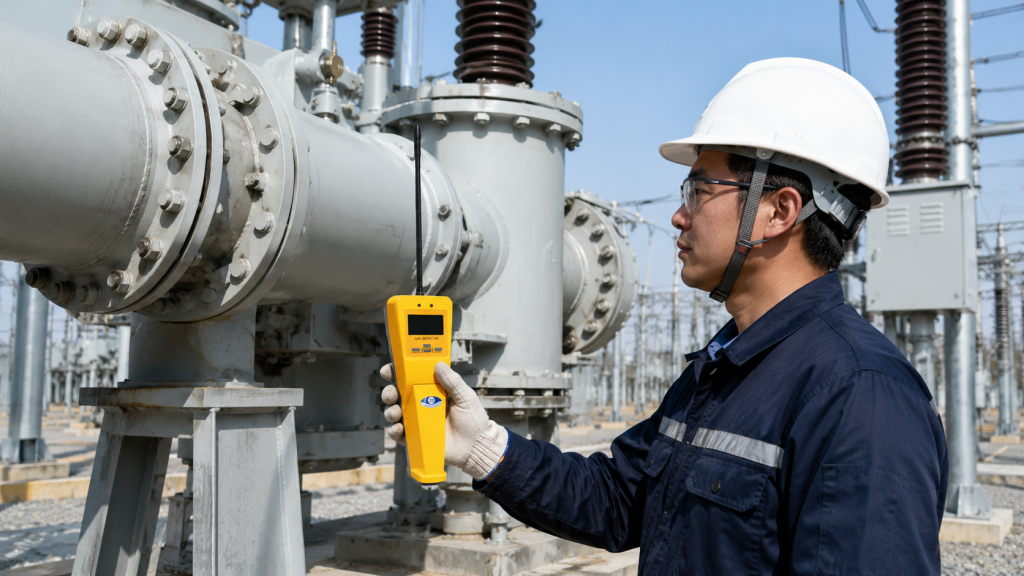
Relations portable SF6 leak detector is useful for locating a specific leak. In an indoor GIS room or underground substation, a fixed monitoring system can provide continuous warning when the surrounding SF6 concentration increases.
Mistake 2: Judging Gas Quality by Pressure Alone
Pressure tells you how much gas may be in the compartment. It does not tell you whether the gas is clean enough to reuse.
Gas with an acceptable pressure may still contain:
- Excessive moisture
- Air introduced during maintenance
- Oil or particles
- SF6 decomposition products
- Other contaminants
Before recovered gas is reused, it should be tested for the parameters required by the maintenance procedure. Purity, moisture or dew point, and decomposition products are normally the key measurements.
The test result determines whether the gas can be reused after normal filtration, requires additional treatment, or should be sent to a regeneration system.
Without analysis, technicians are making a decision without the information they actually need.
Mistake 3: Selecting a Service Cart by Flow Rate Alone
A large compressor number may look impressive on a product sheet, but it does not describe the complete recovery process.
Recovery speed changes as the pressure inside the gas compartment drops. A machine that performs well at higher pressure may slow down considerably near the end of recovery.
Equipment selection should also consider:
- Gas compartment volume
- Required final recovery pressure
- Available storage capacity
- Whether gas will be stored as a gas or liquid
- Hose length and connection size
- Ambient temperature
- Required recovery time
- Frequency of maintenance work
For a small ring main unit, a compact mobile service cart may be enough. Large GIS compartments, switchgear production lines and centralized gas-treatment projects require a different configuration.
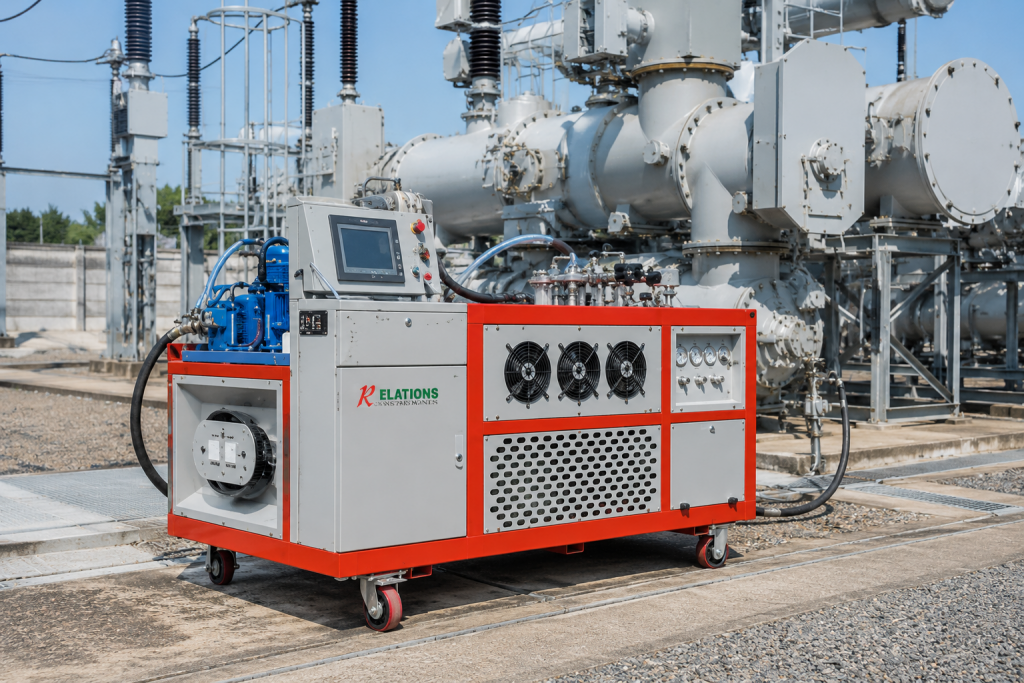
The right question is not “Which machine has the biggest compressor?” It is “Which system can complete the entire job within the required time?”
Mistake 4: Forgetting the Air Inside Hoses and Connections
A switchgear compartment may be properly evacuated, but the maintenance result can still be compromised by air trapped inside the hoses.
When an unevacuated hose is opened to the compartment, the trapped air and moisture may enter the electrical equipment. The quantity may appear small, but repeated maintenance can gradually affect gas purity and moisture levels.
Before recovery or refilling:
- Check that the hoses are clean and dry.
- Inspect seals and connections.
- Evacuate the hose and manifold.
- Confirm valve positions before opening the gas path.
- Use self-sealing couplings where appropriate.
This is a simple step, but it is often the difference between controlled gas handling and accidental contamination.
Mistake 5: Treating Purification and Regeneration as the Same Process
Purification and regeneration are related, but they are not always interchangeable.
A service cart usually purifies recovered SF6 by passing it through filters and drying materials. This process can remove or reduce moisture, particles, oil and certain decomposition products.
Regeneration is intended for gas that requires deeper and more controlled treatment. It may involve repeated circulation, several treatment stages, larger adsorbent systems and testing before the gas is approved for reuse.
In practical terms:
- Purification is often part of routine recovery and maintenance.
- Regeneration is used when ordinary filtration is not enough.
Sending every batch of gas for full regeneration wastes time and operating cost. Reusing heavily contaminated gas after basic filtration creates a different risk.
Gas analysis should determine which process is required.
Mistake 6: Refilling to a Pressure Number Without Considering Temperature
Gas pressure changes with temperature.
If a compartment is filled on a cold morning and checked again during a hot afternoon, the pressure reading may be different even though no gas has leaked.
This is why technicians should not treat the pressure gauge as an isolated number.
A controlled refilling process should consider:
- Ambient temperature
- Equipment temperature
- The manufacturer’s filling requirements
- Gas density or temperature-compensated pressure
- Stabilization time after filling
- Accuracy of the regulator and measuring instruments
Filling too quickly can also produce unstable readings. After reaching the target condition, allow the gas and equipment temperature to stabilize before confirming the final value.
Finally, inspect every connection that was opened during maintenance.
Mistake 7: Ending the Job Without Records or a Final Check
A maintenance job is not complete when the hose is disconnected.
Without proper records, the next technician cannot tell whether a falling pressure is a new problem or part of a longer trend.
A useful maintenance record should include:
- Equipment and compartment identification
- Initial pressure or density
- Leak inspection result
- Gas purity and moisture values
- Decomposition-product readings
- Amount of gas recovered
- Treatment method
- Vacuum level
- Amount of gas refilled
- Final pressure or density
- Operator and maintenance date
The final check should also confirm that valves are closed, caps are fitted, connections are clean and no leakage is detected.
Good records turn a single maintenance visit into useful information for the next inspection.
Better SF6 Maintenance Starts With the Whole Process
The most expensive maintenance mistakes rarely come from one dramatic failure. They usually come from small steps that were skipped, rushed or never recorded.
A reliable SF6 maintenance process connects:
Leak detection → Gas analysis → Recovery → Purification or regeneration → Vacuum evacuation → Controlled refilling → Documentation
SF6 in Switchgear provides equipment for each stage, including leak detectors, room monitoring systems, gas analyzers, SF6 service carts, vacuum pump units, filling equipment and gas-regeneration systems.
The equipment should be selected according to gas volume, required recovery time, final pressure, gas condition and site working conditions—not by one specification alone.
Need Help Selecting SF6 Handling Equipment?
Send us the following information:
- Gas compartment volume
- Required recovery time
- Final recovery pressure
- Storage method
- Power supply
- Gas condition
- Application and site environment
Relations will recommend a suitable configuration for your maintenance or production process.